The Lockheed U-2 spy plane on its 70th anniversary, Boeing workers strike the St. Louis plant, the NTSB hearing on the DCA mid-air collision, and Injuries due to air turbulence. Also, Micah and Capt. Dana meet up and record the conversation, and news about this year’s Cranky Dorkfest.
Lockheed proposed the U-2 Dragon Lady spy plane in 1953, it was approved in 1954, and its first test flight took place in 1955, seventy years ago. According to ATC radio traffic, the U-2 just set several records, including an “endurance record for category and class for aircraft.” During the Cold War era, the U-2 flew over the Soviet Union, China, Vietnam, and Cuba. Gary Powers was shot down in a CIA U-2 by a surface-to-air missile over the Soviet Union in 1960. Major Rudolf Anderson Jr. was shot down in 1962 during the Cuban Missile Crisis.
The International Association of Machinists and Aerospace Workers (IAM) recommended that members accept Boeing’s four-year contract offer for the St. Louis plant. Instead, union membership voted to authorize a strike, potentially disrupting the production of Boeing aircraft.
Approximately 3,200 highly-skilled IAM Union members at Boeing facilities in St. Louis voted to reject a modified four-year labor agreement with Boeing. This vote follows members’ rejection of Boeing’s earlier proposal on Sunday, July 27.
At a National Transportation Safety Board (NTSB) investigative hearing, the FAA said additional changes will be made to a key helicopter route near Ronald Reagan Washington National Airport. This follows restrictions imposed in March and June. At the hearing, NTSB officials expressed concerns about the FAA failing to turn over documents in a timely manner, inaction by the agency after earlier reports of close calls, and a “disconnect” between controllers and FAA leaders.
“An aviation attorney says passengers on the Delta flight could be entitled to $250K in compensation.” The turbulence was encountered on a Delta Airbus A330-900 flying from Salt Lake City to Amsterdam. The plane diverted to Minneapolis, and 25 passengers and crew members were hospitalized.
Dinner With Dana
Captain Dana, an A320 family pilot, visited with Micah and talked about flying, his background, and how he traveled to Maine.
Guest Scott Hamilton is fresh from the Paris Air Show, and we talk about next-generation aircraft and engines, industry sustainability, the supply chain, and Boeing’s path back. Also, an NTSB safety recommendation for the CFM Leap-1B engine, and the possibility of restarting production of the C-17.
Guest
Scott Hamilton
Scott Hamilton is the Founder and Managing Director of Leeham Company and has spent more than four decades in the commercial aviation industry. Leeham News and Analysis has been a go-to source for spotting trends and providing verified, credible, relevant aviation news that’s impartial and unbiased. Leeham Consulting Services provides expertise in several areas, including aircraft economic analysis, lease and return condition analysis and negotiations, aircraft product and strategy analysis, fleet planning and contract negotiations, market demand analysis, and MRO strategy.
In our conversation with Scott, we looked at some of the technologies that may appear in next-generation aircraft. That includes ducted and unducted engines, as well as developments with geared fans. In public, the OEMs tout their own technology choices, but in reality, they are quietly working on multiple options.
We touch on Boeing’s ability to make the financial investment required to proceed with a single-aisle replacement, and on the company’s path to recovery.
Scott provides some observations on this year’s Paris Air Show, including the low-key participation by Boeing. Scott offers his thoughts on electric aircraft, alternative fuels, and the airline industry goal for net-zero carbon emissions by 2050.
Scott’s book, Air Wars: The Global Combat Between Airbus and Boeing, was published in 2021. This coming September, a sequel titled The Rise and Fall of Boeing and the Way Back will be published and available on Amazon.
Boeing issued a request for information (RFI) to engine manufacturers for advanced ducted propulsion systems in the 30,000-lb-thrust class. That thrust class is suitable for powering a future single-aisle replacement for the 737. Rolls-Royce and Pratt & Whitney are likely to respond to the RFI with geared, ducted turbofans, which they are proposing to Airbus for its next-generation single aisle (NGSA). CFMI will likely respond with a ducted engine based on technology from its Revolutionary Innovation for Sustainable Engine (RISE) unducted open fan program.
Each engine OEM has a vision for future engines (open fan, ducted fan, geared fan), but is each company also developing an alternative at the same time? PW’s sister company, Pratt & Whitney Canada, has publicly disclosed its development of an Open Fan engine for a new 70-100-seat aircraft designed by the start-up company MAEVE Aerospace.
Two bird strike incidents in 2023 with CFMI LEAP-1B engines caused smoke to enter the ventilation system. The NTSB has issued an urgent safety bulletin, asking operators to inform flight crews of the potential hazard and calling for modifications to engine software. The NTSB notes that Boeing has revised flight manuals. GE Aerospace says it had already made changes.
The NTSB found that the engine load reduction device, or LRD, a safety feature designed to reduce the severity of vibrations transmitted from a damaged engine to the airframe, can result in damage to the engine oil system. Such a condition can allow smoke from hot oil to enter the ventilation system and ultimately the cockpit or passenger cabin.
Production of the McDonnell Douglas/Boeing C-17 Globemaster III ceased a decade ago. There is no immediate successor to the C-17, but there is demand for the capability that the airplane can provide. Boeing says it’s negotiating with at least one potential customer.
Mentioned
Jim Schilling, Co-Host/Producer of the Flying Midwest Podcast, has organized an Aviation Podcaster Q and A forum at Oshkosh. Saturday, July 26th, 2025 11:30-12:45, Forum Stage 6.
Southwest Airlines files to fly to all Open Skies countries, the TSA explains last year’s New Jersey drone scare, a Lufthansa A321 flew for 10 minutes without a pilot at the controls, sleep and fatigue in military aviation, a new direction for the Boeing criminal charge, and lithium-ion fires onboard airplanes. Also, a resurrected aviation podcast and a brand new one.
Southwest Airlines filed a request with the U.S. Department of Transportation (DOT) to fly international routes to all countries with Open Skies agreements. That would include European countries, Latin America, Asia, and Africa. The airline has not confirmed specific new routes yet.
International air travel is governed by bilateral and multilateral agreements between countries, and so airlines need economic authority from the DOT. These Open Skies treaties set the terms for airlines to operate between nations, including route rights, frequency, and capacity.
Economic Authority is authorized by the Office of the Secretary of Transportation in the form of a certificate for interstate or foreign passenger and/or cargo authority.
In December 2024, the President said the “drone” sightings were “nothing nefarious.” Congress received a classified briefing indicating no threat to the public, but the FAA imposed flight restrictions. At the time, TSA presented an internal slideshow (“official use only”) showing four incidents as normal air traffic. That slideshow is now publicly available.
Spanish investigators say the Captain on Lufthansa flight LH1140, an A321, took a toilet break, and then the First Officer in the cockpit suffered a “sudden and severe” incapacitation. The Captain had difficulty getting through the security door and the plane flew for 10 minutes without anyone at the controls.
The report titled Management of Sleep and Fatigue in Military Aviation [PDF] was published by the Congressional Research Service on May 13, 2025, and examines the effects of sleep deprivation and its impact on operational readiness and aviation safety.
The report highlights that military aviators face significant psychological and physiological demands, which can lead to sleep deprivation and fatigue. These conditions are exacerbated by factors such as unpredictable schedules, long-duty days, challenging flight conditions, and disruptions to circadian rhythms due to crossing multiple time zones. Research has shown that sleep deprivation negatively affects cognitive, physical, and emotional functioning, increasing the risk of accidents in training and combat environments.
To mitigate these risks, the Department of Defense employs both non-pharmacological and pharmacological strategies. Non-pharmacological measures include administrative policies that limit duty hours, regulate flight schedules, and educate aviators on the importance of sleep. Pharmacological measures, such as FDA-approved medications, are used selectively when behavioral strategies are insufficient.
The report also discusses congressional considerations regarding fatigue management policies and their effectiveness in ensuring aviator safety and mission success.
In an online meeting, U.S. Department of Justice (DOJ) officials told families of the 737 Max crash victims that the Government may allow Boeing to sign a non-prosecution agreement to settle the case. This would avoid the criminal fraud trial scheduled to begin on June 23, 2025. An earlier settlement agreement was rejected by a judge.
A DOJ official said after the meeting that a decision has not yet been made to go to trial or proceed with a nonprosecution agreement. Also that Boeing and DOJ have not yet negotiated the final details of any nonprosecution agreement.
However, past guest Erin Applebaum represents 34 families of those killed in the Ethiopian crash and said, “While DOJ claims no final decision has been made, their scripted presentation made it clear that the outcome has already been decided.” She added, “Boeing has never stood trial for the 346 lives lost due to its admitted crimes. Now, DOJ is prepared to let the company walk away, again, with no more than a financial penalty.”
David Wroth, Senior Director of Technology and Systems for UL Standards & Engagement, says fires typically involve batteries that are damaged or abused, and sometimes substandard or counterfeit batteries. The TSA requires that power banks, cell phone charging cases, and spare laptop batteries must be placed in carry-on baggage only.
The UAV Digest podcast is returning, hosted by David Vanderhoof and Max Trescott. The show will be renamed UAV News Talk. Also, a new podcast called NTSB New Talk has started publishing. Follow both in your favorite podcast app.
A report from the Seattle Aerospace Bash, Boeing’s strategic divestments, Avelo Airlines’ controversial charter flights, Electra’s innovative aircraft technology, Lockheed Martin’s future fighter jet developments, and Boeing’s reacquisition of Spirit AeroSystems.
Seattle Aerospace Bash
The Seattle Aerospace Bash (Formerly BBQ) was held April 5th, 2025, at the Museum of Flight View Room, in Seattle, Washington. Aerospace enthusiasts and geeks gathered to celebrate the year ahead in aviation and space. In addition to food, activities included an aerospace swap meet, a sticker/freebie table, Isaac Alexander’s aerospace trivia contest, and an aerospace raffle with various prizes.
Isaac Alexander and participants at the Seattle Aerospace Bash.
Brian Coleman spoke with organizer Isaac Alexander about the Seattle Aerospace Bash. Isaac is known as Jet City Star on many social media platforms, and he’s the Chief Content Officer at the Hype Aerospace Insights service.
Brian also had a conversation with Brian Wiklem about aerospace memorabilia and the aviation documentaries he produces as a hobby. Find avgeektv on YouTube and at avgeektv.com.
Boeing has entered into a definitive agreement with software investment firm Thoma Bravo to sell portions of its Digital Aviation Solutions business. The all-cash transaction is valued at $10.55 billion. Thoma Bravo would acquire the assets of Jeppesen, ForeFlight, AerData, and OzRunways.
Jeppesen provides flight planning tools, and navigation charts. It was acquired by Boeing in 2000.
ForeFlight offers an electronic flight bag and was acquired in 2019.
AerData specializes in lease management, engine fleet planning, and records management. It was acquired 2014.
OzRunways produces an electronic flight bag and maps for drone operators in Australia. That company was acquired 2024.
Boeing will retain Digital Aviation Solutions’ fleet maintenance, diagnostics, and repair service elements. That organization currently employs approximately 3,900 people worldwide. Subject to regulatory approval, the transaction is expected to close by the end of 2025. Thoma Bravo has over US$179 billion in assets under management as of December 31, 2024.
Avelo Airlines previously announced it would operate deportation charter flights for the Department of Homeland Security. This sparked protests against the airline at Charles M. Schulz Sonoma County Airport in California, at Daytona Beach International Airport in Florida, and near Wilmington Airport in Delaware.
Avelo Airlines generates profit by leveraging its ultra-low-cost carrier model. Key strategies include low operating costs, ancillary revenue, efficient fleet utilization, use of secondary airports, and lean staffing.
Avelo’s Cost per Available Seat Mile (CASM), excluding fuel, is only 6.6 cents.
CASM = Total Operating Costs / Available Seat Miles (ASM)
ASM is the number of available seats times the distance flown.
Typical CASM for different airline business models:
Electra.aero is developing the eight-engine hybrid-electric EL9 Ultra Short, a 9-passenger, high-wing aircraft. The company claims a 150-foot ground roll, 75 dBA at 300 feet, and 40% lower fuel burn. The target market is regional aircraft. The Ultra Short technology demonstrator is undergoing flight testing. The first eSTOL flight was May 16, 2024.
John Langford is the founder and CEO of Electra.aero. He is a member of the National Academy of Engineering and the immediate past President of the American Institute of Aeronautics and Astronautics (AIAA). He founded Aurora Flight Sciences in 1989, Athena Technologies in 1998, and Electra.aero in 2020.
After losing the F-47 NGAD contract to Boeing, Lockheed Martin has returned by promoting a Super F-35. Lockheed Martin Chairman, President, and CEO Jim Taiclet says the company plans to incorporate technologies from Lockheed’s NGAD bid to create an upgraded F-35. Taiclet calls it a “fifth-generation-plus” fighter. The claim is that this F-35 variant could provide almost 80% of sixth-gen capabilities, but cost about half the projected F-47 cost.
Spirit AeroSystems was originally spun off from Boeing in 2005, but Boeing is now re-acquiring the company. That deal is expected to close in the third quarter of 2025. Boeing has reached a definitive agreement with Airbus SE to divest some Airbus-related assets, including:
Kinston, North Carolina (A350 fuselage sections)
St. Nazaire, France (A350 fuselage sections)
Casablanca, Morocco (A321 and A220 components)
Wichita, Kansas (A220 pylon production)
Belfast, Northern Ireland: (Production of A220 wings and the A220 mid-fuselage)
Prestwick, Scotland: (A320 and A350 wing component production)
Airbus will receive US$439 million in compensation from Spirit AeroSystems to ensure Airbus takes ownership of Spirit’s facilities and operations tied to Airbus programs. The closing of the transaction is planned in the third quarter of 2025. The Airbus asset divestiture and the Boeing merger are subject to regulatory approvals.
Also, Airbus has an agreement with Spirit AeroSystems to provide Spirit AeroSystems with US$200 million in non-interest-bearing lines of credit to support Airbus programs.
Finlets are patented by Vortex Control Technologies (VCT). The company focuses on aerodynamically controlling vortices emanating from the aft fuselage of aircraft.
Challenges faced by charter operators in deportation flights, the NTSB’s new online accident reporting portal, rising military aviation accident rates, the uncertain future of Air Wisconsin, and the merger of regional carriers Republic and Mesa. Also, findings from the NTSB regarding Boeing evacuation slides, the impact of Temporary Flight Restrictions (TFRs) on businesses, innovations in helicopter technology, and the legacy of women in aviation, particularly the WASPs during World War II.
Miami-based Global Crossing Airlines (operating as GlobalX) is a Part 121 operator and the primary contractor for Immigration and Customs Enforcement (ICE) deportation flights. (Known as “ICE Air”). Seven current and former GlobalX flight attendants spoke with ProPublica and expressed concerns about the safety of the deportation flights.
Avelo Airlines plans to begin flying deportation flights for the U.S. Department of Homeland Security out of Arizona. Connecticut local and state officials are expressing displeasure with the airline. The mayor of New Haven suggested that the state consider pulling its “support” for Avelo.
You can complete the form by either downloading the PDF version or using the interactive digital form, which you can access through a unique link that the investigator will email to you. If you witnessed an aircraft accident and would like to provide the NTSB with a statement of your observations, prepare a statement and email it to witness@ntsb.gov.
The EurAsian Times says, “FY2024 was one of the worst aviation safety years for the US Army in a decade.” They cite statistics from the Aviation Division of the Directorate of Analysis and Prevention at the U.S. Army Combat Readiness Center showing a “steady decline in mishap rates per 100,000 hours beginning in 2006.” FY2022 saw a record low of 0.50 Class A mishaps per 100,000 hours, but that rate doubled in 2023 and the FY2024 Class A mishap rate (1.90) was almost four times greater than FY2022.
American Airlines’ 5-year contract with Air Wisconsin for regional capacity has ended. The April 3, 2025 breakup was announced last January, when Air Wisconsin President and CEO Robert Binns noted that the airline is making a “strategic shift” to focus on government-subsidized Essential Air Service flying and charter operations. To date, the airline has been unsuccessful in winning any EAS contracts.
Republic Airways Holdings Inc. and Mesa Air Group, Inc. announced that they have a definitive agreement to merge in an all-stock transaction. If the merger succeeds, the combined company would be renamed Republic Airways Holdings Inc. Bryan Bedford, Republic’s President and Chief Executive Officer, said “We’re thrilled to combine the Republic and Mesa teams to create one of the world’s leading Embraer Jet operators. Republic and Mesa share a common mission to connect communities across America, and we believe that we can better achieve that mission together. With this combination, we are establishing a single, well-capitalized, public company that will benefit from the deep expertise of Republic and Mesa associates, creating value for all stakeholders well into the future.”
The National Transportation Safety Board (NTSB) recently made seven critical safety recommendations relating to evacuation slides — three to Boeing and four to the FAA. The safety recommendations address the failure of an evacuation slide to deploy normally during an emergency evacuation. NTSB identified the issue during an investigation of an emergency landing involving FedEx flight 1376, a Boeing 757-236, in Chattanooga, Tennessee.
On October 4, 2023, the flight crew of FedEx flight 1376, a Boeing 757-236, received an engine indication and crew alerting system message indicating a failure of the left hydraulic system shortly after takeoff from Chattanooga Metropolitan Airport-Lovell Field (CHA), Chattanooga, Tennessee. The flight crew turned the airplane back to CHA but could not lower the landing gear. The crew declared an emergency and performed a gear-up landing. The flight crew could not open the left (L1) door, and the slide did not deploy.
An attempt was made to open the right (R1) door, but it lodged on the slide pack. With force, the door was opened, the slide deployed, and the crew exited the airplane. Preliminary findings from the NTSB indicate different reasons for the difficulty in opening the L1 and R1 doors to deploy the evacuation slides.
The R1 bannis latch (which releases the slide pack when an armed door is opened) did not conform to the then-current configuration of the release cable assembly.
After the CHA accident, FedEx inspected the L1 and R1 doors on the 97 other airplanes in its Boeing 757 fleet and found no other instances of a misrouted deployment strap.
However, the inspection found 46 doors (about 24%) that were not compliant with other ADs
The NTSB’s review of the Boeing 757 and FedEx aircraft maintenance manuals found that they contain inconsistent depictions of the bannis latch configuration as required by ADs.
New Jersey and Florida lawmakers say their airports suffered harm from the Temporary Flight Restrictions (TFRs) that occur when President Trump visits. They want compensation and sent a letter to Transportation Secretary Sean Duffy and FAA Acting Administrator Chris Rocheleau asking for that from existing congressional funds.
According to the Patch, Congress has allocated $3.5 million annually to compensate businesses that are regularly impacted by TFRs, but funding applications cannot proceed until the FAA opens a Notice of Funding Opportunity.
David Vanderhoof’s History Minute on Instagram from the American Helicopter Museum is about the Navy and Marine Corps celebrating their 250th Anniversary in 2025.
Max Trescott’s We Fly: Skyryse One article in Flying magazine about the Skyryse One helicopter—a single control stick, IFR-certified version of the Robinson R66.
00:00 Introduction to Aviation News and Updates
02:27 NTSB's New Online Accident Reporting Portal
09:17 Deportation Flights and Charter Operators' Challenges
16:40 Rising Military Aviation Accident Rates
26:52 Air Wisconsin's Uncertain Future
32:47 Merger of Regional Carriers Republic and Mesa
35:43 NTSB Findings on Boeing Evacuation Slides
46:11 Navigating Temporary Flight Restrictions (TFRs)
49:40 Congressional Support for TFR-Affected Businesses
50:51 Innovations in Helicopter Technology
56:41 The Future of Helicopter Operations
01:01:43 Women in Aviation: The WASP Legacy
01:11:14 Closing Thoughts
Hosts this Episode
Max Flight, our Main(e) Man Micah, Max Trescott, and Rob Mark.
Political campaign charter aircraft, tariffs and the aerospace industry, Boeings NGAD fighter contract, the adaptive cycle engines to power it, corrosion issues on A220 jetliners, the shutdown of Heathrow, and the resilience of airports to power outages.
Guest
Jonathan Tasler is Vice President at Advanced Aviation Team. He manages charter aircraft for political campaigns and high-net-worth VIPs. We learn what is involved in transporting presidential and other political candidates, and Jonathan tells us some interesting stories.
Jonathan describes how he ensures that a political campaign charter is flown safely to the intended destination on time. We learn that the charter requirements can change as a campaign progresses and presumptive candidates emerge. For example, larger dedicated planes with special campaign livery can become necessary.
Jonathan explains how critical it is that candidates do not miss major events. Sometimes he even arranges backup planes and standby crews. We also discover why some charter airlines don’t want to be involved in political campaigns and others are happy to be part of a campaign. Jonathan also tells us about campaign security and how the Secret Service may participate in some flights.
Jonathan is a veteran of political campaign charters. He grew up in the industry as his father coordinated all the charters for the Bush/Quayle campaign. Over the years, Jonathan has worked with both Republicans and Democrats, including George W. Bush, John Kerry, Mitt Romney, Hillary Clinton, Bernie Sanders, Joe Biden, and many others. He coordinated aircraft charters for a major party candidate in every US Presidential Campaign cycle since the Bush/Cheney campaign in 2000.
The aerospace industry is concerned that tariffs on aluminum and steel will raise manufacturing costs. There is particular concern about tariffs on Canadian and Mexican products since the North American aerospace supply chain is highly integrated. At a recent investor conference, Boeing’s chief financial officer said the direct effects of the tariffs on Boeing would be limited, however, they could impact companies further down the aerospace supply chain. Those suppliers have struggled with material and labor shortages. Kevin Michaels, a past guest and a managing director of the AeroDynamic Advisory consulting firm, said the tariffs could raise costs for the aerospace industry by about $5 billion annually.
The U.S. Air Force has awarded the contract to develop the Next Generation Air Dominance (NGAD) fighter. Lockheed Martin competed with Boeing for the F-47 sixth-generation fighter, while Northrop Grumman dropped out of the competition in 2023. The Engineering and Manufacturing Development (EMD) contract is thought to be worth about $20 billion.
Corrosion was found on some passenger seat fittings and wing components, including the wing-to-body fairing. A220 operator Delta Air Lines told CBS News that some passenger seat fittings will require additional inspection and lubrication.
Delta says the airline “has a sophisticated aircraft maintenance apparatus that is always-on and has many layers to ensure that every aircraft in our fleet is safe to fly by meeting or exceeding standards governed by our regulators. There is broad consensus by our technical experts that these issues aren’t surprising especially for a new, clean-sheet aircraft and pose no major concerns.”
A fire at an electrical substation three miles away shut down the airport. Thousands of flights were flights grounded, diverted to other airports, or turned back. Authorities have said there was no indication of foul play. A counterintelligence unit initially conducted the investigation, but it has shifted to the London Fire Brigade. According to the Brigade, the fire was fueled by 25,000 liters of cooling oil.
Heathrow Airport’s chief executive told BBC that Heathrow does have backup power stations, they are “not designed to power the entire airport.” NBC News reported that British tabloids suggest Russia may be involved, but there is no official evidence.
The GAO’s Aug 29, 2023 report states: “Twenty-four of the 30 commercial service airports that responded to GAO’s survey and interviews reported experiencing a total of 321 electrical power outages—i.e., an unplanned loss of power lasting 5 minutes or longer—from 2015 through 2022. Eleven of these airports reported having six or more outages over this 8-year period. Airports reported that these outages affected a range of airport operations and equipment. Not all responding airports were able to provide detailed information about their outages, and some provided estimates about affected activities.”
“Selected airports reported taking several actions to improve the electrical power resilience of their airports, including (1) conducting electrical infrastructure assessments, (2) undertaking projects to improve electrical infrastructure, and (3) installing equipment to generate additional backup power. For example, 40 of the 41 airports GAO interviewed reported planning or completing an infrastructure project to increase electrical power resilience. Of these, four airports reported installing microgrids. Such microgrid systems are capable of independently generating, distributing, and storing power.”
The FAA is administering new and expanded grant programs and issuing guidance to support airports’ electrical resilience efforts. For example:
Airport Improvement Program funding eligibility was expanded to include the Energy Supply, Redundancy, and Microgrids Program projects, which may include certain electrical power resilience projects.
The new Airport Terminal Program provides funding for airport terminal development projects, including those that may strengthen resilience.
FAA issued program guidance and conducted airport outreach to help increase airports’ awareness of available federal funding for resilience projects.
A pilot on a SAS Connect flight from Oslo to Manchester has been fined after failing to maintain continuous radio communication with NATS. A security incident was declared and two RAF Typhoons intercepted the aircraft.
A United Airlines flight from Los Angeles to Shanghai had to divert to San Francisco after one of the pilots realized he had left his passport at home. Once on the ground, it became clear that the crew wouldn’t have enough hours to legally work for such a long flight, so the passengers had to be deplaned while United went on the hunt for an entirely new crew of pilots and flight attendants. With the delay, the crew wouldn’t have enough hours left so the passengers deplaned while United looked for a fresh crew.
Hosts this Episode
Max Flight, our Main(e) Man Micah, Max Trescott, David Vanderhoof, and Rob Mark.
UAP safety risks with Todd Curtis, a troubling wave of US Army aviation accidents, the impact of aviation accidents on public perception of safety, the Flexjet order for Embraer jets, and Boeing’s worries about the future of the Space Launch System.
Guest
Todd Curtis
Todd Curtis is a risk consultant who systematically uses data to understand and reduce aviation incidents. He is also a co-host of the Flight Safety Detectives podcast, which evaluates accidents, incidents, and risks from all areas of aviation.
Todd explains that UAP safety risks are not separate and distinct from other safety issues, and lessons learned from UAP encounters may carry over to one or more other aviation risks. The recent interview with the Flight Safety Detectives about the UAP’s close encounter with a sailplane (Hair-Raising UAP Encounter Shared by Pilot – Episode 252) illustrates a key crossover between UAP and other aviation risks. Todd argues that the key challenge is to develop a fundamental understanding of UAP and a set of shared goals and definitions that will serve to support processes that will identify, reduce, or eliminate UAP-related aviation risks.
Todd has spent most of his aviation career focusing on aviation safety. After earning electrical engineering degrees at Princeton University and the University of Texas, he served as a flight test engineer in the U.S. Air Force. After earning master’s degrees from MIT, one in policy and another in management, he was a safety engineer at Boeing, where he supported accident investigations and conducted safety analyses during the development of the 777. His 2000 book, “Understanding Aviation Safety Data,” described his approach to analyzing aviation risk and evaluating accident and incident trends.
[Paywall] The Army had 15 Class A flight accidents in fiscal 2024 that claimed 11 lives. In 2023 there were 9 Class A flight accidents that killed 14. Army crash investigators say 82% of the accidents over the past five years were primarily caused by human error. The Army has acknowledged that inexperienced aircrews are a problem.
Public concern about air safety is growing with news of the fatal crashes in Washington, DC, Philadelphia, and Alaska, as well as other incidents such as the wing of a Japan Airlines 787 striking the tail of a stationary Delta Airlines 737, and a United A319 with an engine fire during takeoff. Experts point out the overall safety of the system, but is it enough to influence perception?
Global fractional ownership provider Flexjet announced the order for 182 Praetor 600, Praetor 500, and Phenom 300E models to be delivered over the next five years. The deal includes 30 options and an enhanced services and support agreement.
Boeing’s vice president and program manager for the Space Launch System (SLS) rocket announced to employees at an all-hands meeting that Boeing’s contracts for the rocket could end in March. Boeing was planning for layoffs of about 400 in case the cost-plus contracts were not renewed. Boeing is the primary contractor for the Space Launch System rocket. The Worker Adjustment and Retraining Notification (or WARN) Act requires US employers with 100 or more full-time employees to provide a 60-day notice in advance of mass layoffs or plant closings.
Memorable Flybys
Listener Tom describes a low-level flyover by a pair of F-84 jets.
We speak with a Partner at an aviation practice who advocates for 737 MAX crash victims. In the news, we look at the Azerbaijan and Jeju crashes, Boeing’s safety and quality-control plan update, Delta’s plan for an AI-rich future, and V-22 Osprey catastrophic failure risks. Also, favorite flybys from listeners.
Guest
Erin Applebaum is a partner in the aviation practice at Kreindler & Kreindler LLP, specializing in high-stakes litigation for passengers injured or killed in general aviation accidents and commercial airline disasters.
Erin has devoted her career to advocating for justice and fighting for the advancement of aviation safety. She serves on the Plaintiffs’ Executive Committee for the Ethiopian Airlines Flight 302 Boeing 737 MAX litigation. Erin is part of the legal team representing the 737 MAX crash victims in the federal criminal case against Boeing.
Erin updates us on the status of the 737 MAX crash civil litigation. The criminal case is ongoing but likely nearing an end. Boeing was found in violation of the deferred prosecution agreement but the judge rejected the negotiated plea deal. The families of the victims are unhappy because the criminal case focuses on the single charge of defrauding the FAA, and not on those who lost their lives.
Erin maintains a robust practice of litigating tort claims governed by the Montreal Convention, the global treaty governing international commercial flights. She teaches a popular aviation CLE course for other attorneys on how to litigate personal injury claims for international airline passengers. Erin has published a comprehensive update on the law governing international aviation claims in the highly respected legal journal of McGill University, “Annals of Air and Space Law.”
On December 25, 2024, an Azerbaijan Airlines ERJ-190 flying from Baku Azerbaijan to Grozny in Russia’s Chechnya crashed in Aktau Kazakhstan leaving 38 people dead. The plane diverted from Grozny due to dense fog and ultimately made an emergency landing an hour later in Grozny. On final approach, the Embraer lost altitude and impacted the ground off the runway. Twenty-nine people, including the cabin crew, survived. Thirty-eight, including the flight crew, did not
“Civil aircraft must never be the intended or accidental target of military operations. The strong potential that Azerbaijan Airlines flight 8243 could have been the victim of military operations, as indicated by several governments including Russia and Azerbaijan, places the highest priority on conducting a thorough, transparent, and impartial investigation. The world eagerly awaits the required publication of the interim report within 30 days, in line with international obligations agreed in the Chicago Convention. And should the conclusion be that this tragedy was the responsibility of combatants, the perpetrators must be held accountable and brought to justice.”
Boeing provided an update of its plan to address systemic safety and quality-control issues, which included:
Reducing 737 fuselage assembly defects at Spirit AeroSystems through increased inspection and a customer quality approval process;
Addressing more than 70% of the action items from employee feedback
Managing traveled work at final assembly with “move ready” criteria
Adding hundreds of hours to employee quality and safety training programs
Performing random quality audits of documented removals
Mapping thousands of governance documents and work instructions for revision.
Strengthening the Speak Up program to ensure whistleblower confidentiality and keep employees informed about the status and resolution of their reports.
In One Year after Boeing Door Plug Incident, FAA Administrator Whitaker says “We have conducted an unprecedented number of unannounced audits; and we conduct monthly status reviews with Boeing executives to monitor progress. Our enhanced oversight is here to stay,”
By Seth Miller (@wandrme.paxex.aero on Bluesky.) Delta Air Lines CEO Ed Bastian described the airline’s future in his keynote presentation at CES in Las Vegas: A system powered by Generative Artificial Intelligence (GenAI) will predict where it can help travelers and provide assistance. Bastian described it as “A thread across your experience, a GenAI-powered assistant that anticipates your needs and provides recommendations.”
Delta also announced some major IFE content partnerships, including:
YouTube will provide “highly curated” ad-free content on personal devices and seatbacks that will include music, podcasts, and regular videos.
Retired quarterback Tom Brady will host a video series called “Well Traveled.”
DraftKings will provide “gaming” offerings on the in-seat IFE.
A Naval Air Systems Command (NAVAIR) system safety risk assessment found that the Bell Boeing V-22 Osprey fleet will continue to face a “serious” risk of catastrophic failure. This is despite actions to mitigate the failure of transmission gears due to an impurity in the X-53 steel used to make the gears, creating a weak point. The inclusions were estimated to result in a catastrophic failure frequency of seven per million flight hours. Serious risk is considered to be one failure per million flight hours.
The Jeju Boeing 737-800 was performing a flight from Bangkok to Muan in South Korea. The plane attempted to land with all gear up, slid down the runway, and impacted a concrete embankment about 300 meters (1000 feet) past the runway. The 737 burst into a fireball. Of the 175 passengers and six crew, two people were rescued alive, both cabin crew. The investigation is considering the possibilities of bird strikes and landing gear problems.
The U.S. Senate hearing on airline fees, a Boeing employee surveillance program, the judge rejects the 737 MAX plea deal, Airbus floats a cockpit idea for Extended Minimum Crew Operations (eMCO), and a study will look at how high-G flying might affect Naval fighter pilots. Also, ticket sales for EAA Air Venture Oshkosh 2024 and FlightSimExpo, Brian’s 2024 travels, fly-by-wire airplanes and smuggling Cessnas into Russia.
Airline executives testify at a Senate Subcommittee. (Screen capture courtesy PBS NewsHour.)
The U.S. Senate Permanent Subcommittee on Investigations held a hearing on December 4, 2024 about airline fees charged for baggage, seat selection, and other services. Executives representing American Airlines, United Airlines, Delta Air Lines, Frontier Airlines, and Spirit Airlines testified. Testimony included:
Airline fees – Committee Chairman Sen. Richard Blumenthal consistently referred to these as “junk fees.” In opening remarks, airlines characterized fees as allowing the consumer to create and pay for the experience they want – unbundling.
“Bag bounty” programs – Sen. Hawley was quite antagonistic. Frontier removed their program September 30 that paid gate attendants for checking carry-on bags.
Pricing – The Senators wanted to know why personal information is collected before the ticket price is given and the use of dynamic pricing based on the personal data. They also (unsuccessfully) probed the airline executives for the cost of the services covered by fees, assuming that price is related to cost.
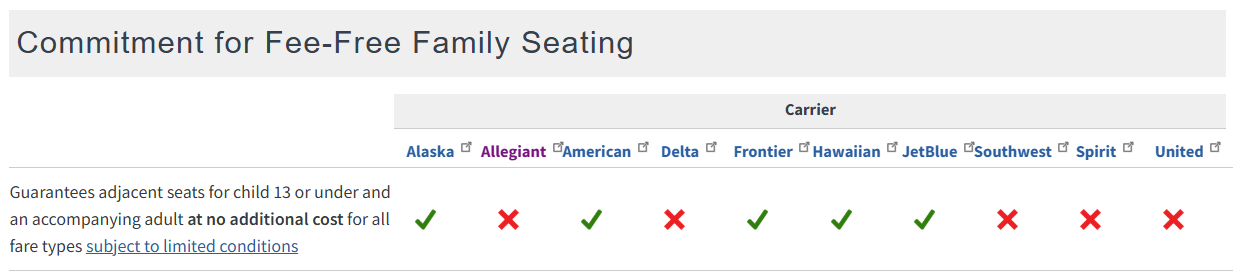
Family seating – Sen Hassan and others argued for fee-free family seating and sometimes confused a fee and the ability to accommodate. See the DOT Airline Family Seating Dashboard.
DOT Airline Family Seating Dashboard
Loyalty programs – Sen Marshall characterized credit card programs as being about “voodoo miles” and the revenue to the airlines as a “kickback.”
Competition – Spirit Airlines Matthew Kline was very critical of legacy airlines saying Spirit is at a competitive disadvantage over slots. Also that the majors paid pilots to retire during Covid, then poached Spirit pilots when demand returned.
Overall, there was bipartisan demand that the airlines change junk fee practices, and two people should not be charged different prices for the same service on the same flight. It was evident that AI was on the minds of all, with airlines starting to think about applications and Senators afraid of what the technology could do.
Speaking for their respective airlines were
Steve Johnson, vice chair and chief strategy officer, American Airlines;
Peter Carter, chief external affairs officer, Delta Air Lines;
Andrew Nocella, EVP and chief commercial officer, United Airlines;
Robert Schroeter, SVP, chief commercial officer, Frontier Airlines;
and Matthew Klein, EVP and chief commercial officer, Spirit Airlines
Boeing had started to install sensors “in ceiling tiles above workstations, conference rooms, and common areas.” The sensors included motion detectors, cameras, and light, heat, and noise detectors. Boeing the data on building use for “managing energy and space usage.” According to Boeing, the cameras could take only blurry photos and AI would analyze the occupancy of the space. Only aggregated data would be presented to management.
After details of the program appeared in the Seattle Times, Boeing employees reacted as expected. Within a day, a Boeing email stated the program “has been canceled, and we are removing the sensors that have been installed.” See Surveilling Employees Erodes Trust — and Puts Managers in a Bind
The U.S. Department of Justice brokered a plea agreement with Boeing over the fatal 737 MAX crashes under which Boeing would plead guilty to deceiving the FAA. However, a U.S. district judge has rejected the deal saying the agreement was “not in the public interest.”
The judge questioned the selection of the independent monitor by the Justice Department and not the court. In his opinion, the judge wrote “It is fair to say the government’s attempt to ensure compliance has failed. At this point, the public interest requires the court to step in. Marginalizing the court in the selection and monitoring of the independent monitor as the plea agreement does undermines public confidence in Boeing’s probation.”
Boeing and the DOJ now have 30 days to update the court on how they plan to proceed in the case.
The European Air Safety Agency (EASA) is evaluating how to safely implement Extended Minimum Crew Operations (or eMCO) with the regulatory processes expected to begin in 2025 and implementation by 2027. Under eMCO, Airbus is exploring ideas to reduce the number of pilots on ultra-long-haul flights, which might be three or four. Currently, two pilots remain on the flight deck at any one time while others can sleep in the crew rest compartment. With eMCO, only one pilot would be in the cockpit and the other would be sleeping. Pilot unions are not enthusiastic.
The Extended Minimum Crew Operations – Single Pilot Operations (eMCO-SiPO) project is funded under the Horizon Europe Work Programme 2021-2022. The project focuses on two concepts of operations:
Extended Minimum-Crew Operations (eMCOs) where single-pilot operations are allowed during the cruise phase of the flight, with a level of safety equivalent to today’s two-pilot operations. Offering at least an equivalent overall level of safety through compensation means (e.g. ground assistance, advanced cockpit design with workload alleviation means etc.) eMCO is, in particular, relevant to large aeroplanes operated in CAT [commercial air transport] operations, for which no fewer than two flight crew members are currently required as per the Air Operations Regulation.
Single-Pilot Operations (SiPOs), where, at a later stage, end-to-end single-pilot operations might be allowed, offering at least a level of safety equivalent to today’s two-pilot operations provided that compensation means are in place (e.g. ground assistance, advanced cockpit design with workload alleviation means, capability to cope with pilot incapacitation etc.).
“Odin’s Eye” is a confidential Navy project looking at the possibility of warfighter brain injury. It was originally created to look for brain injuries in Navy SEALs, but is now expanded to include TOPGUN aviators who take frequent high-G flying flights in the F/A-18 Super Hornet. The project will look at about 1,500 data points on brain function for the TOPGUN pilots to understand the cumulative effect and identify any injured pilots.
Brian Coleman’s 2024 Passport
Brian recorded a year-end summary of his 2024 travels. [4:14]
Mentioned
Discount coupon for The Air Current. $15 for a three-month subscription. Use coupon code AGPOD. Offer good through December 31, 2024. Note: This offer is not sponsored.
Registration for FlightSimExpo 2025 opens on December 14, 2024. The 2025 Expo is June 27-29, 2024 at the Rhode Island Convention Center in Providence RI. FlightSimExpo welcomes devs to register to sponsor, exhibit, and speak. Details at flightsimexpo.com/partner. Attendees can book discounted hotel rooms and airfare deals now. Details at flightsimexpo.com/travel.
An AI governance framework for aerospace and defense, airlines pad flight times and improve on-time performance, record numbers of travelers over the Thanksgiving holiday, stowaways on airline flights, and executive-level cost-cutting at Boeing.
Guest
Tim White is the Vice President of Engineering and Technology at the Aerospace Industries Association (AIA), where he advocates for the technical workforce to policymakers. In this role, he leads AIA staff and members in identifying, developing, and executing consensus programs and activities aimed at enhancing cost savings, performance, and efficiency within the aerospace and defense industry.
The AIA released the AI Flight Plan, Best Practices for AI Governance in Aerospace, a first-of-its-kind document outlining comprehensive best practices for the governance of Artificial Intelligence (AI) use for aerospace and defense. The framework outlines the elements of an AI governance program that targets three primary usages of AI in aerospace:
Business operations enhancement
Generative systems design and development
Integration into customer-delivered products, software, and services.
Tim has over 20 years of experience in operational and consulting roles within the aerospace and defense industry, having worked for companies such as Raytheon, Honeywell, and Bechtel. Throughout his career, he has contributed to commercial and defense products and held leadership positions in Engineering, Operations, Supply Chain, and Quality. Most recently, he has collaborated with advanced technology companies like Interos and Mosaic Data Sciences, focusing on delivering cutting-edge solutions in artificial intelligence, advanced analytics, and digital transformation.
Tim holds a Bachelor of Science and Master of Science in Mechanical Engineering, an MBA from Brigham Young University, and a Ph.D. in Systems Engineering from George Washington University. He is also certified in Six Sigma, Root Cause Analysis, and Change Leadership.
According to a NYT Upshot analysis of Bureau of Transportation Statistics data, airlines strategically add extra time to their flight schedules, effectively “padding” their flight durations. This leads to a higher percentage of flights arriving on time or early even if the actual flight time hasn’t significantly changed. This improves airline on-time performance metrics.
The Transportation Security Administration said it screened about 3.09 million people on Sunday, the peak of the busy Thanksgiving travel period. The previous record set in July was 3.01 million travelers. The TSA reports that their 10 busiest days were recorded in 2024.
The woman, a U.S. resident, boarded a Delta flight from JFK to Paris Charles de Gaulle Airport and was discovered midair. She had been hiding out in the lavs and the flight attendants noticed the strange behavior. The TSA said the woman passed through a body scanner at JFK, evaded the document and ID check portion, had her bags scanned, proceeded to the gate, and snuck onto the flight.
The Delta Paris Stowaway Incident Keeps Getting Stranger – The stowaway was a 57-year-old woman living in the Philadelphia area. She’s a Russian national who holds a US Green Card. She requested asylum in Paris, which was rejected. The woman was placed on a return flight but pulled off after a disruptive outburst.
The 19 members of Boeing’s executive council have access to five Bombardier Challenger 650 business jets and two Boeing 737’s. To cut costs, CEO Kelly Ortberg grounded some of the corporate fleet and asked executives to fly economy on scheduled airline flights. For security reasons, Boeing’s CEO is required to avoid commercial flights, even for personal trips. But Ortberg is relocating to Seattle.
In other cost-cutting moves, Boeing is eliminating 17,000 jobs that include management and making a list of non-core businesses to potentially sell or close. The company canceled the lavash rooftop party at the Singapore Grand Prix, pulled sponsorship of the Washington International Horse Show, sat out a commercial and defense air show in China, and did not attend the annual meeting of Asian airlines.
Mentioned
Discount coupon for The Air Current – $15 for three months. Use coupon code AGPOD for a quarterly subscription. The Coupon is good through December 31, 2024. Note: This is not a sponsored offer.